

Book Chat: Maura Pierlot
I’m very excited to welcome Maura Pierlot back for another Book Chat. The last time we caught up here, just over a year ago, Maura had recently released her wonderful rhyming picture book, Clutterbugs. Now Maura is back with another powerhouse of rhyme, Our Family Zoo, and I’m relishing the chance to pick her brain about it.

Thanks for dropping by again, Maura! I’m keen to know how the last 14 months have been for you, creatively? Quite active, it seems!
Thanks for the opportunity to chat, Cam. The past fourteen months have been wonderfully chaotic. Creatively, The Lies We Tell Ourselves, a young adult novel very close to my heart, was released last August. I’m delighted by how strongly readers of all ages are still connecting with the work. Late last year, I rediscovered early draft chapters for two middle grade novels that were born during the first 2020 lockdown. Progressing them has been both a challenge and a joy. I’ve been writing poetry—something I’ve always done but have kept close, as my poems tend to be deeply personal and partly confessional. But I’ve started to share my poetry, which has opened up more than I expected.
Beyond writing, I spent six glorious weeks travelling across Canada last northern autumn, then on through the U.S.—an ideal mix of breathtaking landscapes, ambitious walking adventures and precious time with friends and family.
But perhaps the greatest story of the year was the Valentine’s Day arrival of our first grandchild, a beautiful girl who has changed our world in the most wonderful ways.
Congratulations to you and your family, Maura. That is a very special arrival indeed.
Our Family Zoo is such a fun book that delights and entertains throughout, and pays off handsomely with a big surprise near the end. I’d love to know a little about the origin of this story, and whether rhyme was part of the equation from the very beginning.
In Our Family Zoo, a young boy living in a house full of animals wants yet another pet; his mother, on the other hand, seems far from convinced. Animals have been part of my world for as long as I can remember. I grew up in a small apartment in the Bronx and couldn’t have a pet until age 12, when we moved to a house in the suburbs. Until then, I was always playing with other people’s animals and spending time down the road at the Bronx Zoo.
The word ‘pet’ implies ownership, with the human in charge of the animal’s wellbeing. But in my experience, it runs both ways. Animals look after us too, often in ways we don’t even realise. They’re our genuine companions, friends and confidants, and I’m convinced they know a lot more than we think. Today, our two energetic bordoodles, Archie and Lola keep us endlessly entertained. We share our farm on the NSW south coast with ‘the locals’—echidnas, wombats, lyrebirds, kangaroos, kookaburras, wallabies, deer, lizards and more. Every creature that wanders through leaves us a little more in awe of nature. We think of ourselves as caretakers, looking after the land for them and for those who come after us.
So in many ways, Our Family Zoo is an ode to the animals in my life. More generally, it’s a story about how animals can change families, and how families can grow in so many ways. Like my middle grade WIPs, this book was written during the first lockdown in early 2020. It began as a story about a boy who had no friends, and engaged with animals more easily than with people. But stories have their own instincts, and this one morphed into something else entirely.
As for rhyme: I’m not sure why, or how, but I’ve always heard music in words. I love the playful energy, rhythm and melody of language, making rhyme a natural fit. Although I never set out to write rhyme, some stories, like this one, just seem to arrive that way.

You are certainly on a roll with rhyme, and with books for younger readers. Were there any particular differences or challenges this time around, as compared to the writing process for Clutterbugs?
Placing a rhyming story with a publisher is always a challenge. Some publishers won’t consider rhyme for commercial reasons (rhyming text doesn’t translate well for overseas markets). Others are open to rhyme but seem to have been worn down by rhyme that doesn’t work. When many publishers say they don’t want rhyme, they’re really saying they don’t want bad rhyme. Rhyme is more than the last syllables rhyming in a pattern; it’s about the accents and beats; it’s about rhythm. It’s easy to spot poorly executed rhyme: clunky metre, odd word choices made to force a rhyme or pattern, a story getting lost along the way.
Given all this, the onus has been shifted to rhyme, which now has to justify why it’s needed in a way that prose doesn’t have to. The result: fewer and fewer rhyming books are being written, submitted and published. This is a huge potential loss because rhyme is one of the most powerful tools available for literacy. Rhyme and rhythm help young readers anticipate language and develop an instinctive feel for how words work. And thankfully, publishers like Scholastic Australia understand, appreciate and champion good rhyming stories for children.
Your poetic writing is admirably strict in terms of its rhyme and metre, but this doesn’t limit the energy and expression you pack into Our Family Zoo. Can you offer some advice to other writers about finding an ideal balance between poetic conventions and the full expression of ideas? Does working within these strictures in any way make the process easier?
Many writers shy away from rhyme for commercial reasons; others, because they find the form limiting. I treat metre and rhyme as a framework, one that requires precision. Every word must earn its place, which actually sharpens expression rather than obscures it. I think the starting point for writers is to learn metre inside out. You have to really understand it so you can instinctively feel whether a line is singing or limping. It’s important to read your work aloud constantly. See and hear the words you trip over. Then read it again, pretending it doesn’t rhyme—just read for story. And if the story is lost, or muddled, or too slow to sustain interest, then the rhyme isn’t working. If you ever catch yourself trying to squish an idea to fit a rhyme, that’s another signal that the rhyme is off.
Whether rhyme as a framing device helps or hinders the writing process depends on the writer. I find that the structure and constraints that rhyme offers can make writing easier. The real challenge is writing rhyme that’s effortless to read and propels the story with every beat. That means the metre, in a sense, should be invisible; the rhymes should feel natural, never engineered.

I love that we never know about the relationship status of the mother in Our Family Zoo, and that the story makes space for a range of definitions of family. Was this something you intentionally set out to achieve with your manuscript?
The simple answer is yes and no! As a general guide, I rarely if ever sit down and map out all the elements of a story before starting to write. This may seem odd, given I just said I often consider the structure of rhyme to be helpful (I am full of contradictions!). I admire plotters and disciplined writers who work towards a specified word count each day, but my brain simply doesn’t operate that way. Usually, I’ve lived with a story for some time in my head, and when I put pen to paper, I know little more than the characters, conflicts and underlying themes. The story will invariably tell me where it needs to go.
The ambiguity of the mother’s relationship status started off more as instinct than intention. I knew I wanted the mother to be calm, present, joyful, loving—to serve as a counterpoint of sorts for her son’s frenetic energy. The more I write, the more I’m learning that less is more. Ambiguity provides space for young readers to find themselves on the page, to ask questions, and to fill in their own blanks.
I don’t think anyone could write a story like Our Family Zoo without having a profound love for animals. I’d love to know how you feel that animals, and the natural world more broadly, inform your writing.
As I mentioned earlier, animals have been my companions, teachers and confidantes for a long time. More recently, our farm offers a quieter way of living that lends itself to contemplation, observation and introspection—key ingredients for writing and living well. We spend so much time in life searching for the big moments, but lately, I’ve learned that the most real and valuable stories are often found in the small things.
My relationship with nature has changed, too. Growing up in New York City, nature was something you ‘visited’. Central Park was a green haven, offering welcome relief from the concrete jungle. In later years, nature was something I ‘escaped’ to. My jobs in politics and journalism were highly stressful, so spending a weekend in nature—canoeing, camping, bushwalking—allowed me to reset. These days, I feel like I ‘live’ in nature. I don’t visit, or escape to it, when I need to recharge. I try to live and connect with it every single day.
Animals and nature are good distillers that help us see what matters. Spending time with both has taught me to slow down, be present and appreciate the quiet moments. And with this, comes an element of clarity that often inspires and fuels my writing and other creative pursuits.
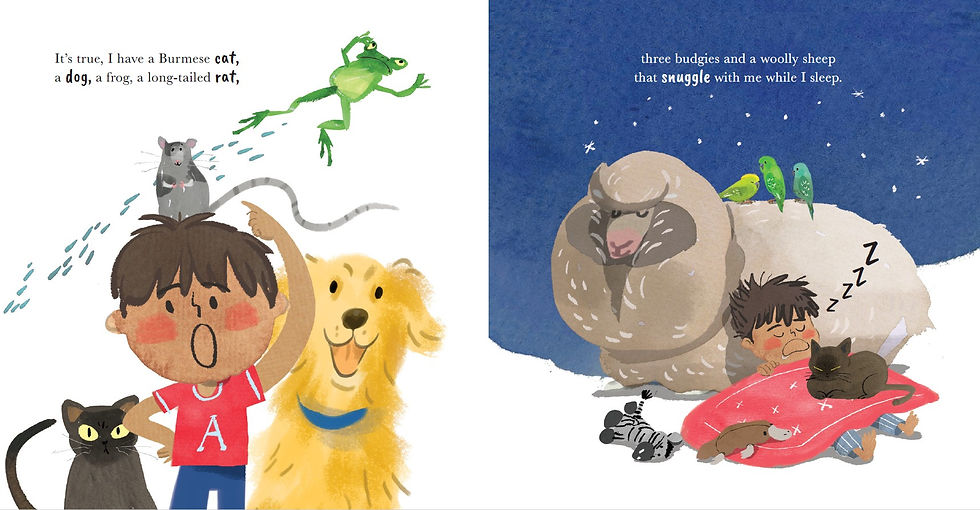
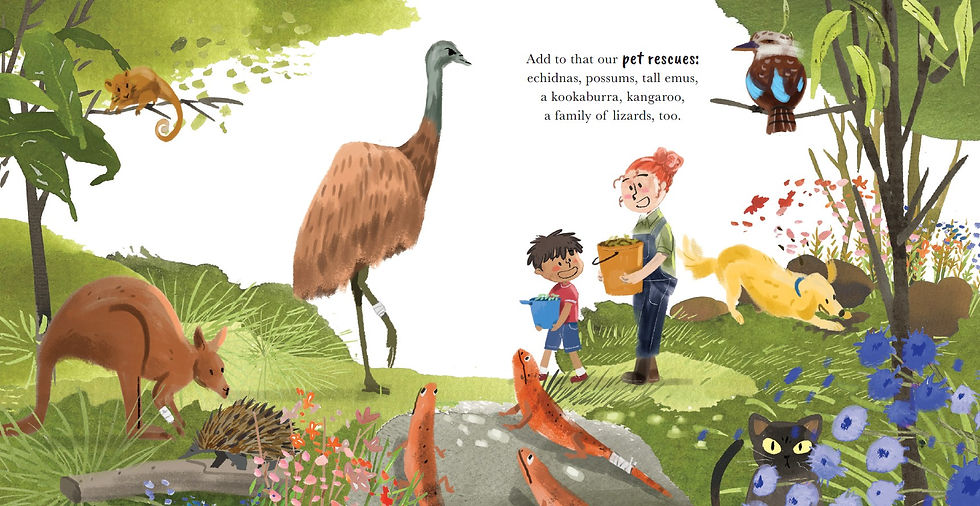
As well as your wonderful writing, I was knocked over by the brilliance of the artwork in Our Family Zoo. The energy of A. Yi’s illustrations matches the energy of the text so well. Were you very involved in the development of the illustrations as they were brewing?
I wish I could claim an iota of credit for Anne’s beautiful drawings, but I can’t. I wasn’t involved in the conceptual or creative development of the illustrations. I did tell the publisher the type of style I imagined, and when they said they had contracted A. Yi, I was over the moon. I’m finding that each publisher works differently—some actively involve the author in creative development, others only when an issue arises, and some, not at all. For someone of Anne’s calibre, skill and experience, I was delighted to sit back and let her weave her magic.
What’s next for Maura Pierlot?
I’m about to take Our Family Zoo on the road—two weeks in Victoria and southeast SA, combined with some big family events. I’ve been selected for a children’s writers and illustrators residency program at Nan Tien Temple later this year, where I’m hoping to progress a picture book manuscript and one of my middle grade WIPs. My memoir is quietly taking shape, exploring belonging, identity and loss. I’m writing it for me, but I’ve been so heartened by feedback from beta readers that I’m thinking maybe it will find its way into the world one day. My poetry writing is ongoing. I find I often turn to this form when I’m trying to work through something, or as a creative exercise (especially prose poetry).
The farm keeps us grounded and busy—there’s always something to dig, transplant, grow, fix, understand and learn. I try to do as much reading and travelling as time allows. We’re hoping to go to Ireland and the UK next year. I have good reason to believe that trip will be a source of great inspiration, personally and professionally.
Where are the best places for people to find you online, and to follow Our Family Zoo as it makes its way into the world?
I’m most active on Instagram (@maurapierlot_author), which mirrors to my Facebook page (@maurapierlotauthor). I have been drifting away from LinkedIn, TikTok etc because multiple platforms were quietly consuming me. My websites are another good source of up-to-date information: maurapierlot.com; bigideaspress.com.
Maura, thanks so much. It's been a pleasure to learn even more about your approach to writing, about which you share so generously. I really hope you have incredible success with Our Family Zoo, and look forward to our next chat!
This post is part of a blog tour for Our Family Zoo, presented by Books On Tour PR & Marketing. Please keep following Maura's jountey with Our Family Zoo on all of the brilliant blogs and pages below.


Comments